
Houston's Worst Traffic Times: When to Book Your SafeTrip Ride

If you live in Houston, you already know one thing timing can make or break your day. A smooth 25-minute Houston commute can quickly turn into a 75-minute crawl. Whether you’re planning your daily Houston office commute, managing a Katy office commute, or traveling from Sugar Land to downtown Houston, understanding peak congestion windows helps you avoid wasted time and daily frustration.
With more than 7 million residents in the Greater Houston metro area, congestion isn’t random, it’s predictable. In this guide, you’ll learn when Houston traffic is at its worst, how corridors like I-45 traffic patterns affect reliability, and the best time to commute in Houston so you can schedule your SafeTrip ride strategically.
What You’ll Learn in This Blog
- Why traffic congestion keeps increasing across major Houston highways
- The worst morning and evening peak windows
- How Interstate bottlenecks impact daily travel time
- Timing strategies that reduce delays by up to 40%
- Why structured commuting is becoming more popular
- How to book smarter and avoid daily gridlock
Why Houston Traffic Feels Worse Every Year
According to the Texas A&M Transportation Institute Urban Mobility Report, Houston drivers lose 60+ hours per year in traffic congestion. That’s more than a full workweek spent idling.
Growth is the primary driver. Expanding suburban communities like Katy, Sugar Land, and Cypress push more vehicles onto major Houston highways such as:
- Interstate 10 (I-10 West / Katy Freeway)
- Interstate 45 (I-45 North & South)
- Interstate 69 (US-59 corridor)
The Texas Department of Transportation reports steady increases in traffic counts along I-10 West and I-45 North over the past decade. More drivers + limited roadway expansion = longer peak delays.
Morning Houston Rush Hour (6:30 AM – 9:00 AM)

Morning Houston rush hour starts earlier than many expect.
Peak congestion window: 7:00 AM – 8:30 AM
Average delay: 35%–50% longer than off-peak travel
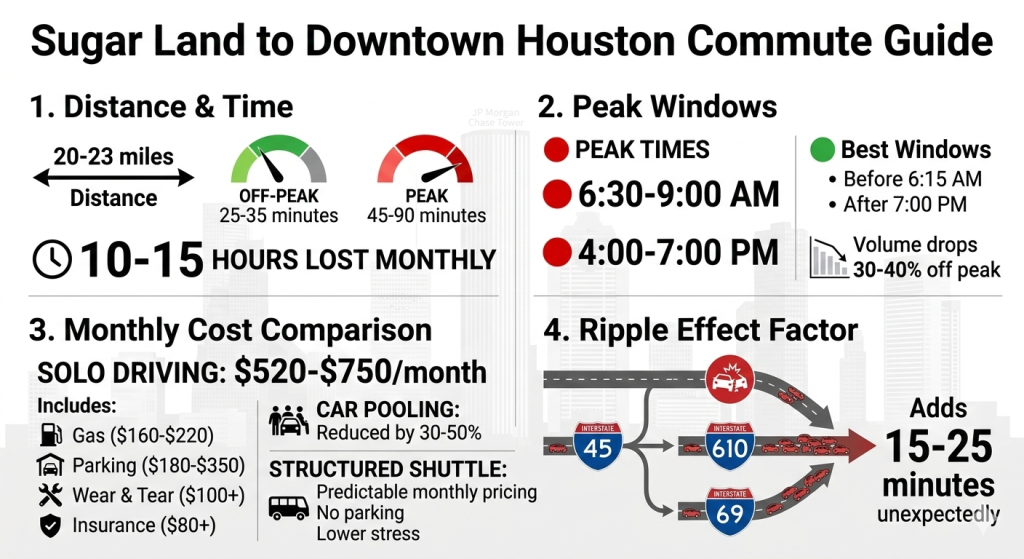
If you’re commuting from Sugar Land to downtown Houston, a standard 30-minute trip can extend to 60–70 minutes during this window.
I-45 traffic north and south of downtown slows dramatically during school months. Even minor fender-benders can trigger backups lasting an hour or more.
Strategic Timing Tip
For a fixed Houston office commute, departures:
- Before 6:30 AM
- After 9:15 AM
can significantly reduce exposure to stop-and-go congestion.
Evening Congestion Is Often Worse
Evening traffic tends to be more volatile than mornings.
Peak evening window: 4:00 PM – 6:30 PM
Travel speed reductions: Up to 60%
Outbound lanes toward Katy and Sugar Land become heavily congested. The Katy office commute along I-10 West is especially challenging what should be a 35-minute drive often exceeds 75 minutes on Fridays.
Structured commuting options like Houston car pooling or scheduled shuttle services help convert that lost driving time into productive time instead of high-stress steering-wheel frustration.
The Reality of I-45 Traffic
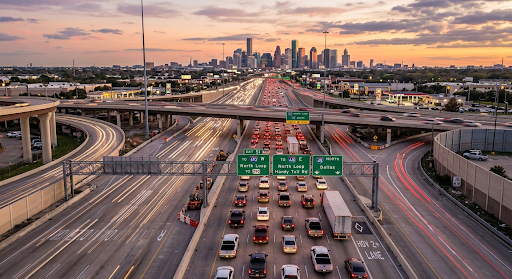
Few corridors test commuter patience like Interstate 45.
It remains one of the most heavily traveled and construction-impacted highways in Texas. Congestion intensifies near the 610 Loop and downtown interchange zones.
Common choke points include:
- I-45 North near Beltway 8
- Downtown split interchanges
- Southbound merges during evening Houston rush hour
Real-time updates from Houston TranStar can help, but departure timing remains the most reliable control variable.
Katy and West Houston: Growing Pressure
West Houston expansion continues to intensify the Katy office commute along Interstate 10.
During peak congestion:
- Speeds drop below 20 mph
- Delays increase by 45% or more
For professionals considering Katy car pooling, shared commuting reduces per-person fuel costs and helps lower the number of single-occupancy vehicles contributing to Houston traffic buildup.
Sugar Land to Downtown Houston: A Critical Corridor
The Sugar Land to downtown Houston route via Interstate 69 is one of the region’s busiest.
Normal conditions: 25–30 minutes
During Houston rush hour: 50–70 minutes
Congestion typically builds after 6:45 AM. A 30-minute earlier departure can cut total travel time by 20–30 minutes.
If arrival downtown by 9:00 AM is mandatory, a 6:15 AM departure is far safer than a 7:15 AM gamble.
Best Time to Commute in Houston
Based on traffic flow patterns and commuter data:
Best Morning Windows
- Before 6:30 AM
- After 9:15 AM
Best Afternoon Window
- 1:00 PM – 3:00 PM
Traveling during these off-peak periods can reduce congestion exposure by 25%–40%.
Avoid:
- 7:00 AM – 8:30 AM
- 4:30 PM – 6:30 PM
Scheduling outside these windows dramatically improves reliability.
The Cost of Driving Alone
Peak Houston traffic doesn’t just cost time it costs money.
The average commuter spends thousands annually on:
- Fuel
- Insurance
- Parking
- Maintenance
- Depreciation
Houston car pooling and structured commuter services reduce direct vehicle expenses while also lowering stress levels and improving arrival consistency.

Commuting and Productivity
Research published by the Harvard Business Review indicates that longer commute times correlate with higher stress and reduced workplace productivity.
Arriving fatigued from I-45 traffic or prolonged Houston highways congestion impacts performance, focus, and overall well-being.
Reducing commute volatility isn’t just logistical it’s strategic.
Take Control of Your Houston Commute
You can’t eliminate Houston rush hour, but you can control how you move through it.
Whether you’re navigating a daily Houston office commute, handling a Katy office commute, or traveling from Sugar Land to downtown Houston, strategic timing makes a measurable difference.
Book Smarter. Travel Calmer.
With SafeTrip, you can:
- Reserve your seat before peak congestion hits
- Avoid unpredictable delays on major Houston highways
- Choose reliable Houston car pooling or Katy car pooling options
- Align your ride with the best time to commute in Houston
- Reduce fuel costs and daily driving stress
A simple 30-minute shift in departure time can save 20–40 minutes per day adding up to more than 100 hours per year reclaimed.
Don’t Gamble With Peak Traffic
Avoid the 7:00 AM scramble.
Skip the 5:30 PM gridlock.
Plan ahead and ride with confidence.
Book your SafeTrip ride today and turn your Houston commute into productive, stress-free time.