
Avoiding Houston's I-45 Nightmare: Smart Commute Alternatives
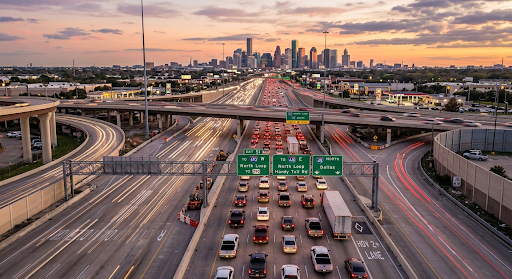
Table of Contents
- Why I-45 Has Become Houston’s Most Notorious Commute
- Alternative 1: Hardy Toll Road , The Best I-45 North Bypass
- Alternative 2: METRO Park & Ride , Let the Bus Beat the Traffic
- Alternative 3: HOV Lanes and Carpooling
- Alternative 4: Rerouting Around I-45 Entirely
- Alternative 5: Shift Your Schedule or Work Remotely
- Alternative 6: Where You Live Changes Everything
- Alternative 7: METRORail for the Final Mile Downtown
- Building Your Personal I-45 Commute Strategy
Nine of the top 25 most congested roadways in Texas are on the I-45 corridor through Houston. More than 100 people died on I-45 in 2023 alone, and traffic volumes on the northern stretch are projected to rise by at least 40% by 2040. If you commute on I-45 every day, you already know this highway is not getting easier any time soon.
The North Houston Highway Improvement Project (NHHIP) is underway a $9.7 billion, 18-year reconstruction of I-45 from Beltway 8 to I-10 and through downtown. Segment 3 construction began in 2024, Segment 2 isn’t expected to start until after 2030, and Segment 1 is targeted for 2032. That means years of lane closures, detours, and unpredictable delays on one of Houston’s most critical highways.
The good news: you have more commute options than you probably realise. This guide walks through seven proven I-45 commute alternatives that Houston drivers are using right now to save time, cut stress, and still arrive on time.
Already thinking about the cost side of Houston commuting? Read our comparison of ridesharing vs. car ownership costs in Houston to see how different transport choices stack up financially.
Why I-45 Has Become Houston’s Most Notorious Commute
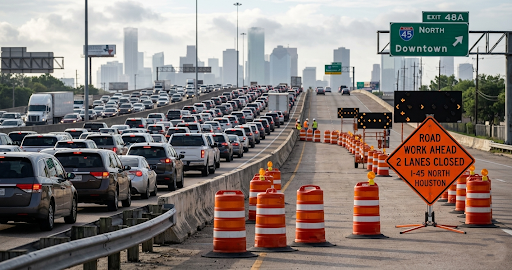
I-45 isn’t just busy, it’s structurally overwhelmed and actively under reconstruction. The highway serves as the main spine connecting downtown Houston to its northern suburbs Spring, The Woodlands, Conroe and to its southern communities: League City, Friendswood, Clear Lake, and Galveston.
According to TxDOT’s NHHIP project overview, the reconstruction spans I-45 from U.S. Highway 59/I-69 to Beltway 8 North, including connecting freeways. The
current HOV lane serves only one direction during peak periods and remains unused for large parts of the day. During rush hour, even the HOV lane is congested.
For daily commuters, this translates to one reality: predictable, multi-year delay. Understanding why the road is broken is the first step to routing around it.
Alternative 1: Hardy Toll Road The Best I-45 North Bypass
If you commute from The Woodlands, Spring, or anywhere along I-45 North, the Hardy Toll Road is your single best detour. Running parallel to I-45 North and connecting to downtown Houston, Hardy consistently moves faster during peak hours than the main interstate, sometimes by 20-30 minutes in each direction.
The road is tolled, but for a daily commuter the time savings more than offset the cost. And if you pair it with an EZ Tag, you get discounted rates across all of Houston’s toll network.
Who Hardy Toll Road Works Best For
- Commuters from The Woodlands, Spring, Conroe, or Tomball heading downtown
- Anyone whose I-45 North drive regularly exceeds 45 60 minutes during rush hour
- Drivers willing to trade a modest toll for predictable, faster travel times
💡 Pro Tip: Get an EZ Tag EZ Tag gives you discounted toll rates on Hardy and every other Houston toll road. For a 5-day-a-week commuter, the annual discount can save $100- $300 compared to paying cash rates. Sign up at hctra.org it takes minutes and the tag pays for itself within weeks. |
Alternative 2: METRO Park & Ride Let the Bus Beat the Traffic
Houston’s METRO Park & Ride system is one of the most underused commuting tools in the entire city and for I-45 corridor riders, it’s a genuine game-changer.
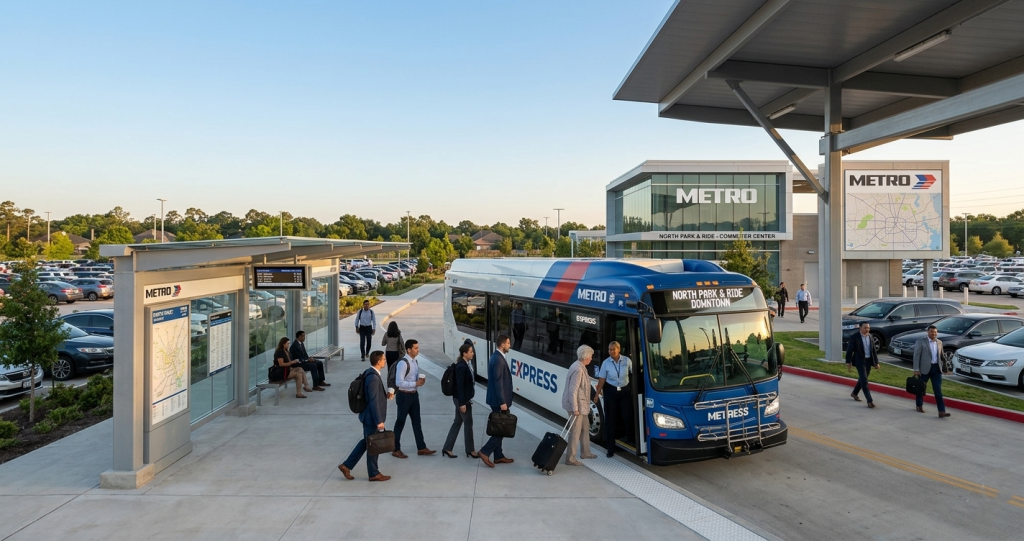
METRO operates express Park & Ride buses that use the HOV lanes on I-45 North and I-45 South bypassing the very gridlock that’s eating your mornings. You park free at a suburban lot, board an express bus, and arrive downtown without touching your steering wheel. One-way fares range from $2 to $4.50 depending on distance far less than fuel, wear, and downtown parking combined.
Key Park & Ride Routes for I-45 Commuters
- I-45 North corridor (The Woodlands, Spring, Kuykendahl): Routes 202 Kuykendahl and 204 Spring run in the I-45 North HOV lane to downtown Houston, running every 15 minutes on weekday mornings
- I-45 South corridor (Clear Lake, Bay Area, Pearland): Routes 246 Bay Area and 247 Fuqua use the I-45 Gulf Freeway HOV lane, serving south Houston commuters heading to the Medical Center and downtown
- Grand Parkway Park & Ride (far north suburbs): Route 222 Grand Parkway runs every 4 minutes at peak hours one of METRO’s most frequent suburban routes
METRO also offers a free Emergency Ride Home program registered commuters get up to three free rides home per year in the event of a midday emergency. It’s a safety net that makes it genuinely practical to leave your car behind. See all Park & Ride routes and schedules at ridemetro.org.
✅ Why Commuters Switch to METRO Park & Ride • Express buses use I-45 HOV lanes bypassing congestion completely • Fares from $2 $4.50 one way (far cheaper than fuel + downtown parking) • Free Emergency Ride Home program for registered riders • Work, read, or decompress on the bus instead of gripping the wheel • METRO’s METRONow initiative is actively improving frequency and reliability in 2025 |
Alternative 3: HOV Lanes and Carpooling Speed Through Together
You don’t have to give up your car to beat I-45 traffic. Houston’s HOV (High Occupancy Vehicle) lanes are open to vehicles carrying two or more people during rush hours on I-45, Highway 59, and Highway 290. The speed difference between a standard lane and an HOV lane during peak hours can be dramatic, sometimes 25 minutes versus 70 minutes for the same route.
The trick is finding a carpool partner. Houston has more tools for this than most residents realise:
How to Find a Carpool Partner in Houston
- The Carma app: Connects Houston commuters with similar routes. Drivers get fuel reimbursement, riders get cheap commutes. One of the simplest rideshare matching tools available for Houston suburbs
- METRO Commute Solutions: A partnership of METRO, TxDOT, and the Houston-Galveston Area Council (H-GAC) that matches commuters along established routes and helps employers set up carpool programs
- Employer carpooling programs: Many large Houston employers, energy companies, the Texas Medical Center, downtown law firms have internal carpool matching programs. Check with your HR department before assuming none exists
- Waze Carpool: The Waze app’s built-in carpool feature connects drivers with riders heading the same direction, with automatic route matching and low-cost fares
💡 Even One Passenger Makes You HOV-Eligible A single carpool partner qualifies you for Houston’s HOV lanes. -Split fuel costs 50/50 and both drivers benefit: cheaper commute AND significantly faster travel. -For a 30-mile, I-45 North commute, HOV-lane access can save 30-40 minutes each way on a congested morning. |
Alternative 4: Rerouting Around I-45 Entirely
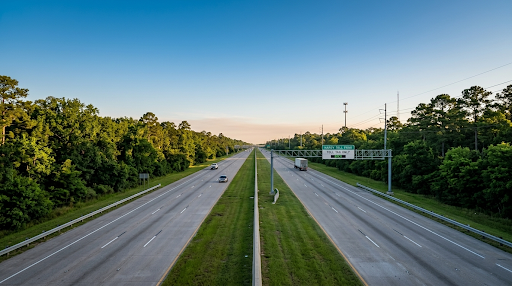
Sometimes the best strategy isn’t managing I-45, it’s avoiding it entirely. Depending on where you’re coming from and where you’re going, several parallel and circumferential routes can cut meaningful time from your commute on bad I-45 days.
Best Alternate Routes for I-45 North Commuters
- Hardy Toll Road: Already covered the fastest I-45 North parallel. Worth repeating because it is that effective
- US-59 / I-69: Runs parallel to I-45 North and generally carries lighter traffic loads. Useful for commuters in Kingwood or Humble heading downtown or to the Energy Corridor
- Grand Parkway (TX-99): The outer ring road circumnavigating Houston. Ideal for suburb-to-suburb commuters avoiding downtown entirely Katy to The Woodlands, for example or for those on the far outer edge of the metro
- Sam Houston Tollway (Beltway 8): Connects I-45 North and I-45 South to virtually every other major Houston highway. Particularly useful for commuters who need to reach the Energy Corridor, the Galleria, or western employment centers without entering downtown
Best Alternate Routes for I-45 South Commuters
- TX-288 (South Freeway): Provides a fast alternative route from south Houston suburbs Pearland, Manvel, Angleton directly to the Texas Medical Center and downtown. Significantly less congested than I-45 South on many mornings
- Beltway 8 South: Connects south suburbs to the broader Houston freeway network and can bypass the worst I-45 South chokepoints, particularly around the I-610 and I-45 interchange
Use real-time navigation every single day. Apps like Waze, Google Maps, and Apple Maps track live traffic, incidents, and construction and dynamically reroute around problems. Waze is particularly effective in Houston because its large user base means incident reporting is fast and accurate. Build familiarity with 2 3 backup routes before you need them, not in the middle of a 7 AM backup.
Alternative 5: Shift Your Schedule or Work Remotely
The simplest way to avoid I-45 traffic is not to commute during peak hours. Houston rush hour hits hardest between 7:00 9:00 AM inbound and 4:30 6:30 PM outbound. Shifting your start time by just 45 minutes can cut your I-45 commute time in half on most mornings.
Flexible Schedule Options to Discuss with Your Employer
- Flexible start/end time: Departing at 6:30 AM or 9:30 AM instead of 8:00 AM avoids the worst traffic windows. The same trip that takes 65 minutes at 8:00 AM can take 25 minutes at 6:30 AM
- Work-from-home days: Even 2 WFH days per week removes over 100 I-45 commutes from your annual schedule more than three months’ worth of round trips
- Compressed work week: 4×10-hour days instead of 5×8 eliminates one full commute day per week. Over a year, that’s 52 fewer I-45 round trips
📊 Time Saved by Shifting Your Departure 8:00 AM departure on I-45 North: ~55 70 minutes (peak rush) 6:30 AM departure on I-45 North: ~22 28 minutes (pre-rush) 9:30 AM departure on I-45 North: ~28 35 minutes (post-rush) Savings: Up to 45 minutes each way = 90 minutes per day = 375 hours per year |
Alternative 6: Where You Live Changes Everything
Alternative 7: METRORail for the Final Mile DowntownThis one requires a bigger decision but it’s also the most permanent solution. Living inside or close to the 610 Loop means many Houstonians never need to use I-45 at all for their daily commute.
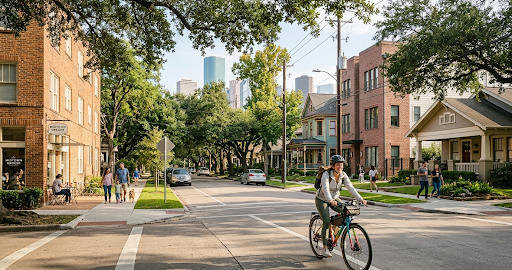
Inner Loop neighborhoods Midtown, Montrose, the Heights, EaDo, Greenway Plaza put residents within a short drive, bike ride, or even walking distance of the largest downtown employment clusters. Their commutes run on surface streets or brief sections of Loop 610, cutting both time and stress compared to any suburban I-45 corridor drive.
For those committed to suburban living, the suburbs with the strongest highway alternatives to I-45 include Pearland (TX-288 access), Katy (I-10 and Westpark Tollway), Cypress (US-290), and Kingwood (I-69 and Grand Parkway). Each of these suburbs offers primary commute routes that don’t rely on I-45 at all. See our Houston neighborhood commute guide for a full breakdown of suburb-by-suburb commute options.
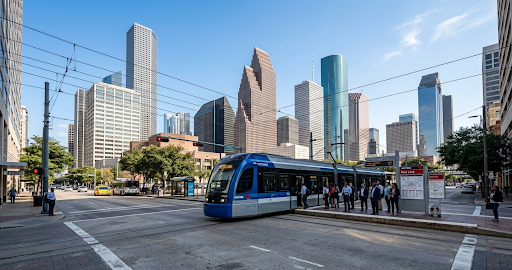
If your destination is downtown, the Texas Medical Center, NRG Park, or anywhere along the Main Street corridor, Houston’s METRORail light rail system handles the final mile more efficiently than driving ever could.
METRORail’s three lines the Red, Green, and Purple connect Midtown, the Museum District, Hermann Park, the Medical Center, and EaDo with downtown Houston. The system is at its most powerful when combined with a METRO Park & Ride: take the express bus from your I-45 suburb into town, then hop the rail to your specific destination. You eliminate parking costs entirely which average $125- $280 per month in downtown Houston and sidestep the last-mile traffic inside the loop.
✅ Why the Park & Ride + METRORail Combo Works So Well • Express bus handles the long suburban leg on I-45 HOV lanes • METRORail handles the downtown/Medical Center final mile • Total door-to-door cost: $2 $5 each way vs. $20 $35/day for fuel + parking • Downtown parking savings alone: $1,500 – $3,360 per year • No traffic stress, no parking hunt, no construction delays in either direction |
Building Your Personal I-45 Commute Strategy
No single alternative works for every Houston commuter. The best approach layers two or three of these strategies together based on your specific origin, destination, and schedule. Here’s a practical five-step framework:
- Map your specific I-45 pain point. Is the bottleneck the downtown interchange? The Beltway 8 merge? A construction zone between two exits? Knowing exactly where I-45 slows down on your route lets you choose the right bypass instead of a generic detour.
- Pick your primary alternative. Hardy Toll Road for I-45 North commuters. METRO Park & Ride for those who can park near a transit lot. A schedule shift for those with flexible employers. Choose one anchor strategy and commit to it for two weeks to properly evaluate it.
- Use real-time navigation every day without exception. Waze and Google Maps adjust dynamically for incidents, construction, and congestion. Even if you’ve driven the same route for years, opening the app before departure gives you the option to reroute before you’re already stuck.
- Layer a second strategy for bad traffic days. On severe congestion days rain, accidents, construction closures have a pre-planned backup. Drive to a Park & Ride lot. Take the Hardy Toll Road. Leave 40 minutes earlier. Know your Plan B before you need it.
- Get an EZ Tag if you haven’t already. If any part of your commute touches Houston’s toll road network Hardy, Beltway 8, the Grand Parkway, the Westpark Tollway an EZ Tag provides discounted rates across the entire system. It pays for itself within weeks for daily commuters.
🗺️ Quick Reference: Best Strategy by Corridor |
time, money, and energy. With the right combination of alternatives, it doesn’t have to be. Start with one change this week, browse METRO’s Park & Ride routes, pick up an EZ Tag, or shift your departure by 45 minutes and measure the difference.
🚗 Thinking About Your Houston Commute or Your Next Move? Where you live in Houston has a direct impact on your commute time, commute cost, and daily quality of life. The right neighbourhood can eliminate an I-45 commute entirely or put you within a 5-minute drive of a Park & Ride lot that changes your mornings completely. Our team specialises in helping Houston residents find homes that work with their commute, not against it. Whether you’re relocating, renting, or just weighing your options, we can help you map out the smartest move. 👉 Contact us today for a free commute-focused consultation and let us help you find a Houston neighbourhood where the drive to work actually makes sense. |
Sources & Further Reading
- TxDOT NHHIP Project Overview txdot.gov/nhhip/about.html
- NHHIP Construction Updates txdot.gov/nhhip/construction-updates.html
- METRO Park & Ride Route Details ridemetro.org
- Downtown Houston Monthly Parking Rates whereipark.com
- H-GAC Commute Solutions Program transit-mobility.tti.tamu.edu