
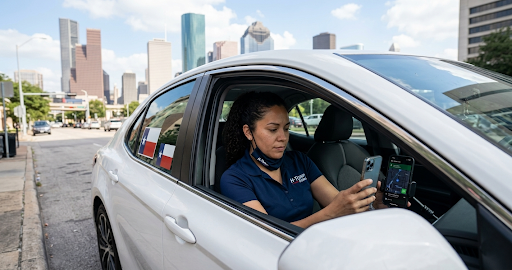
New Texas Rideshare Regulations: What You Need to Know
New Texas Rideshare Regulations: What You Need to Know Texas is one of the most active rideshare markets in the United States , and it is also one of the few states with a comprehensive, state-level regulatory framework that directly governs how Uber, Lyft, and every other Transportation Network Company (TNC) operates. If you drive for a rideshare platform in Houston or anywhere in Texas, understanding those regulations isn’t optional. Getting them wrong can cost you your platform access, expose you to fines, or leave you with a serious insurance gap in the event of an accident. Texas rideshare law has gone through significant evolution , from city-by-city patchwork ordinances, to the landmark House Bill 100 (2017) that created uniform statewide rules, to the most recent development: Senate Bill 2807 (2025), which established a new regulatory framework for autonomous vehicle rideshare operations effective September 1, 2025. On top of the state framework, Houston maintains its own airport-specific rules for drivers working IAH and Hobby. This guide covers everything a Houston or Texas rideshare driver needs to know right now , from driver eligibility and mandatory background checks, to the three-period insurance requirement that most drivers don’t fully understand, to the new AV law that is reshaping the future of the industry. Already thinking about how regulations affect your earnings? Read our full guide to tax deductions every Texas rideshare driver should claim in 2026 for the full financial picture. 📋 Texas Rideshare Regulations at a Glance Regulating body: Texas Department of Licensing and Regulation (TDLR) , statewide TNC oversight Governing law: Texas Occupations Code, Chapter 2402 (Transportation Network Companies) Key legislation: HB 100 (2017) , created uniform statewide framework; SB 2807 (2025) , AV rideshare rules Houston airports: Separate permit required from Houston Airport System (IAH + HOU) Driver license: Required from TDLR , companies, not individual drivers, must hold the TNC permit Contact TDLR: (800) 803-9202 | tdlr.texas.gov/tnc From City Rules to One Statewide Law: What HB 100 Changed Before 2017, Texas rideshare was a patchwork of inconsistent city ordinances. Houston, Austin, San Antonio, and dozens of other cities each had their own rules , creating a compliance nightmare for drivers working across city lines and a competitive disadvantage for the TNCs themselves. The situation reached a breaking point in Austin, where a voter-rejected referendum led Uber and Lyft to exit the Austin market entirely in 2016 rather than comply with local fingerprint background check mandates. On May 29, 2017, Governor Greg Abbott signed House Bill 100 into law. HB 100 moved all TNC regulatory authority from local municipalities to the state government, creating a single uniform framework that applies everywhere in Texas. Overnight, the city-specific ordinances in Houston, San Antonio, Austin, and 28 other Texas cities were voided for TNCs. Uber and Lyft returned to Austin within days of the bill’s signing. What HB 100 Specifically Eliminated (Local Rules No Longer Apply) City-imposed annual TNC operating fees calculated by the number of drivers or vehicles Requirements for TNCs to maintain a local physical presence or 24-hour local phone line City-mandated monthly data reporting requirements Local requirements for vehicle emblems or trade dress beyond what the TNC itself chooses Austin’s fingerprint background check mandate for drivers (replaced with national criminal database check) Hour limits on driver shifts (e.g., Austin’s 12-hour daily driving limit , eliminated statewide) One important exception remains: airports and cruise ship terminals. Under HB 100, airports and governing bodies with jurisdiction over cruise ship terminals retained the authority to impose their own additional regulations and fees for TNCs operating at their facilities. For Houston drivers, this means IAH and Hobby Airport operate under a separate local permit system that runs alongside , but is independent from , the statewide TNC framework. The full text of Chapter 2402 of the Texas Occupations Code is maintained and updated by the Texas Department of Licensing and Regulation (TDLR), which is the state agency responsible for TNC oversight in Texas. Driver Eligibility Requirements Under Texas Law Texas does not issue individual permits or licenses to rideshare drivers. Instead, the TNC company (Uber, Lyft, etc.) holds the state permit from TDLR and is responsible for ensuring each driver it approves meets state-mandated minimum requirements. As a driver, you don’t file paperwork with TDLR directly , but you must meet these baseline standards to be approved by a TNC. Basic Driver Requirements (Texas Occupations Code, Chapter 2402) Minimum age: Must be at least 18 years old. (Note: Uber and Lyft currently set their own minimums at 21 for most services, which exceeds the state minimum) Valid driver’s license: Must hold a valid Texas driver’s license. Drivers who recently relocated to Texas may use a valid out-of-state or DC license , check Texas law for how long an out-of-state license remains valid after establishing residency Driving experience: Most TNCs require at least one year of licensed driving experience. Uber and Lyft currently require at least one year (or three years if under 23) Clean driving record: Major violations within the past 3–7 years are disqualifying, including DUI/DWI, reckless driving, and certain moving violations Vehicle registration: Vehicle must have valid Texas registration and pass the Texas annual vehicle safety inspection Insurance: Must maintain insurance meeting Texas law minimums (see the insurance section below for the full breakdown) Background check: Must pass a multi-tier criminal background check conducted or arranged by the TNC (see below for full requirements) ⚠️ Note: TNC Requirements Can Exceed State Minimums Texas law sets the floor , not the ceiling , for driver requirements. Uber and Lyft both impose additional standards that are stricter than state law requires. Examples: Uber requires a minimum 4.5-star driver rating to remain active. Both platforms regularly reassess drivers who fall below rating thresholds. Platforms may deactivate drivers for reasons not specified in state law , such as too many cancellations, passenger complaints, or inactivity. State law prevents local governments from adding requirements, but