
Complete Commute Guide: Sugar Land to Downtown Houston
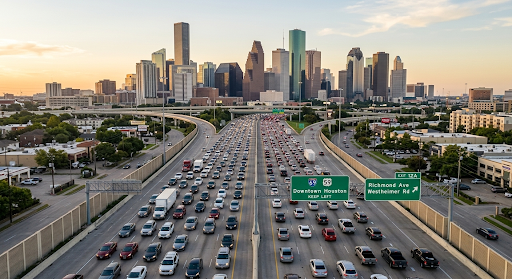
A 25-minute drive can quickly turn into a 75-minute crawl. If you travel from Sugar Land to Downtown Houston, you already know how unpredictable mornings can be. One stalled vehicle, sudden rain, or a surge in Houston rush hour traffic and your entire day starts late.
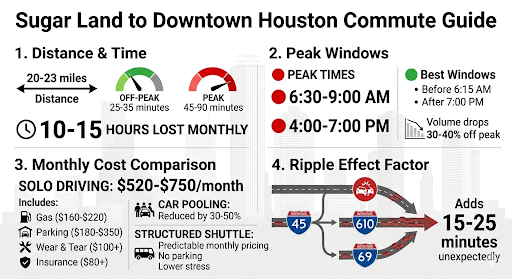
According to regional mobility reports, the average Houston commute ranges between 27–30 minutes citywide, but suburban routes like Sugar Land to downtown Houston often stretch to 45–90 minutes during peak hours. That’s up to 10–15 hours per month lost sitting in Houston traffic.
In this guide, you’ll learn practical ways to reduce stress, save money, and choose the best time to commute in Houston whether you drive, carpool, or use a commuter shuttle service.
What You’ll Learn in This Blog
- Real commute times from Sugar Land to downtown Houston
- The worst Houston rush hour windows to avoid
- How I-45 traffic and other Houston highways affect travel time
- Cost comparison: driving vs Houston car pooling vs commuter bus
- Smart strategies to improve your Houston office commute
- A better alternative for daily travel
Understanding the Route: Sugar Land to Downtown Houston
The typical drive from Sugar Land to downtown Houston is about 20–23 miles, depending on your exact starting point. Most drivers use:
- US-59 (also known as I-69)
- I-610
- I-45 (closer to central corridors)
During off-peak hours, the drive can take 25–35 minutes. But during Houston rush hour (6:30–9:00 AM and 4:00–7:00 PM), travel time often doubles.
Traffic apps like Google Maps and Waze regularly show red congestion lines on Houston highways during these windows.
When Is the Best Time to Commute in Houston?
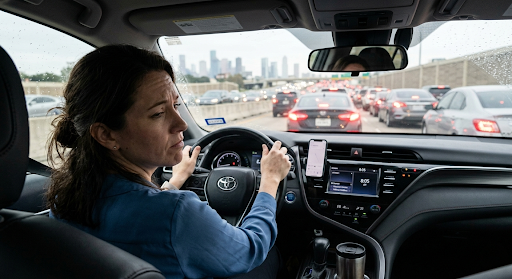
If you want smoother travel, timing matters more than speed.
Morning
- Before 6:15 AM → Most reliable window
- 6:30–8:30 AM → Peak congestion
- After 9:00 AM → Gradual improvement
Evening
- 3:30–6:30 PM → Heavy outbound traffic
- After 7:00 PM → Faster clearance
The best time to commute in Houston is typically early morning or late evening, when volume drops by nearly 30–40% compared to peak hours.
The Real Cost of Driving Daily
Many commuters focus only on fuel costs, but the real expense is much higher.
Here’s a simple breakdown for a 22-mile one-way commute:
Expense | Monthly Estimate |
Gas (22 miles x 2 x 22 days) | $160–$220 |
Downtown parking | $180–$350 |
Vehicle wear & tear | $100+ |
Insurance portion | $80+ |
Total Estimated Cost | $520–$750/month |
That does not include stress or time lost in Houston traffic.
Houston Car Pooling vs Driving Alone
Houston car pooling reduces cost and congestion. Platforms like METRO Houston offer Park & Ride services, while apps like Uber and Lyft provide shared ride options.
Benefits of Houston Car Pooling
- Split fuel and parking costs
- Access to HOV lanes
- Reduce emissions by up to 20–30% per vehicle
However, informal carpools depend heavily on other people’s schedules. If someone cancels, your Houston office commute is disrupted.
What About Katy Office Commute Comparisons?
Commuters traveling from Katy face similar issues. The Katy office commute via I-10 is known for intense slowdowns. Katy car pooling has grown in popularity because solo driving during peak time can push travel beyond 90 minutes.
The lesson? Suburban-to-downtown routes across Houston highways behave similarly during rush hour.
Why I-45 Traffic Impacts Everyone
Even if you don’t directly use I-45 traffic routes from Sugar Land, downtown congestion spills over into connecting highways. Accidents on I-45 often increase pressure on nearby corridors, slowing I-69 and I-610.
This ripple effect means one incident can add 15–25 minutes unexpectedly.
A Smarter Alternative: Structured Commuter Services

Instead of worrying daily about Houston traffic, many professionals now use commuter shuttle services like SafeTrip.
Unlike casual car pooling, commuter buses offer:
- Reserved seating
- Fixed departure times
- Professional drivers
- Comfortable seating with Wi-Fi
- Predictable monthly pricing
For those managing a Houston office commute, this means you can read, work, or relax instead of gripping the steering wheel.
If you frequently travel Sugar Land to downtown Houston, structured commuting may reduce stress levels significantly while offering cost savings compared to solo driving.
👉 Explore route options on our Houston Office Commute Solutions page.
👉 Learn more about Sugar Land Routes available daily.
👉 See how we compare with Houston Car Pooling Options.
👉 Read our guide on Best Time to Commute in Houston.
For additional traffic insights, you can check:
- Texas Department of Transportation traffic updates
- Google Maps live congestion reports
- METRO Houston Park & Ride information
- Regional mobility statistics reports
Final Thoughts: Make Your Commute Work for You
Your daily travel from Sugar Land to downtown Houston doesn’t have to drain your energy. By understanding peak Houston rush hour patterns, evaluating Houston car pooling options, and calculating real monthly costs, you can make a smarter decision.
Instead of losing 10–15 hours each month in unpredictable Houston traffic, choose a commute solution that gives your time back.
Ready for a Better Commute?
Secure your seat, skip the parking struggle, and arrive downtown relaxed.
Visit NextSafeTrip.com today and transform your Houston office commute into productive time.