
New Texas Rideshare Regulations: What You Need to Know
Texas is one of the most active rideshare markets in the United States , and it is also one of the few states with a comprehensive, state-level regulatory framework that directly governs how Uber, Lyft, and every other Transportation Network Company (TNC) operates. If you drive for a rideshare platform in Houston or anywhere in Texas, understanding those regulations isn’t optional. Getting them wrong can cost you your platform access, expose you to fines, or leave you with a serious insurance gap in the event of an accident.
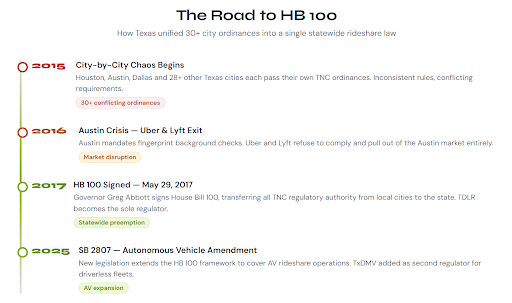
Texas rideshare law has gone through significant evolution , from city-by-city patchwork ordinances, to the landmark House Bill 100 (2017) that created uniform statewide rules, to the most recent development: Senate Bill 2807 (2025), which established a new regulatory framework for autonomous vehicle rideshare operations effective September 1, 2025. On top of the state framework, Houston maintains its own airport-specific rules for drivers working IAH and Hobby.
This guide covers everything a Houston or Texas rideshare driver needs to know right now , from driver eligibility and mandatory background checks, to the three-period insurance requirement that most drivers don’t fully understand, to the new AV law that is reshaping the future of the industry. Already thinking about how regulations affect your earnings? Read our full guide to tax deductions every Texas rideshare driver should claim in 2026 for the full financial picture.
📋 Texas Rideshare Regulations at a Glance
|
From City Rules to One Statewide Law: What HB 100 Changed

Before 2017, Texas rideshare was a patchwork of inconsistent city ordinances.
Houston, Austin, San Antonio, and dozens of other cities each had their own rules , creating a compliance nightmare for drivers working across city lines and a competitive disadvantage for the TNCs themselves.
The situation reached a breaking point in Austin, where a voter-rejected referendum led Uber and Lyft
to exit the Austin market entirely in 2016 rather than comply with local fingerprint background check mandates.
On May 29, 2017, Governor Greg Abbott signed House Bill 100 into law. HB 100 moved all TNC regulatory authority from local municipalities to the state government, creating a single uniform framework that applies everywhere in Texas. Overnight, the city-specific ordinances in Houston, San Antonio, Austin, and 28 other Texas cities were voided for TNCs. Uber and Lyft returned to Austin within days of the bill’s signing.
What HB 100 Specifically Eliminated (Local Rules No Longer Apply)
- City-imposed annual TNC operating fees calculated by the number of drivers or vehicles
- Requirements for TNCs to maintain a local physical presence or 24-hour local phone line
- City-mandated monthly data reporting requirements
- Local requirements for vehicle emblems or trade dress beyond what the TNC itself chooses
- Austin’s fingerprint background check mandate for drivers (replaced with national criminal database check)
- Hour limits on driver shifts (e.g., Austin’s 12-hour daily driving limit , eliminated statewide)
One important exception remains: airports and cruise ship terminals. Under HB 100, airports and governing bodies with jurisdiction over cruise ship terminals retained the authority to impose their own additional regulations and fees for TNCs operating at their facilities. For Houston drivers, this means IAH and Hobby Airport operate under a separate local permit system that runs alongside , but is independent from , the statewide TNC framework.
The full text of Chapter 2402 of the Texas Occupations Code is maintained and updated by the Texas Department of Licensing and Regulation (TDLR), which is the state agency responsible for TNC oversight in Texas.
Driver Eligibility Requirements Under Texas Law
Texas does not issue individual permits or licenses to rideshare drivers. Instead, the TNC company (Uber, Lyft, etc.) holds the state permit from TDLR and is responsible for ensuring each driver it approves meets state-mandated minimum requirements. As a driver, you don’t file paperwork with TDLR directly , but you must meet these baseline standards to be approved by a TNC.
Basic Driver Requirements (Texas Occupations Code, Chapter 2402)
- Minimum age: Must be at least 18 years old. (Note: Uber and Lyft currently set their own minimums at 21 for most services, which exceeds the state minimum)
- Valid driver’s license: Must hold a valid Texas driver’s license. Drivers who recently relocated to Texas may use a valid out-of-state or DC license , check Texas law for how long an out-of-state license remains valid after establishing residency
- Driving experience: Most TNCs require at least one year of licensed driving experience. Uber and Lyft currently require at least one year (or three years if under 23)
- Clean driving record: Major violations within the past 3–7 years are disqualifying, including DUI/DWI, reckless driving, and certain moving violations
- Vehicle registration: Vehicle must have valid Texas registration and pass the Texas annual vehicle safety inspection
- Insurance: Must maintain insurance meeting Texas law minimums (see the insurance section below for the full breakdown)
- Background check: Must pass a multi-tier criminal background check conducted or arranged by the TNC (see below for full requirements)
⚠️ Note: TNC Requirements Can Exceed State Minimums Texas law sets the floor , not the ceiling , for driver requirements. Uber and Lyft both impose additional standards that are stricter than state law requires. Examples: Uber requires a minimum 4.5-star driver rating to remain active. Both platforms regularly reassess drivers who fall below rating thresholds. Platforms may deactivate drivers for reasons not specified in state law , such as too many cancellations, passenger complaints, or inactivity. State law prevents local governments from adding requirements, but it does not prevent the TNCs themselves from setting higher bars. |
Mandatory Background Check Requirements
Texas law requires every TNC to conduct a background check on every driver before they are approved. Under TDLR’s driver requirements, the check must include:
- Multi-jurisdictional criminal check: Local, state, and national criminal background check using a commercial multistate and multijurisdictional criminal records locator or similar national database
- Sex offender registry check: Must include a search of the national sex offender public website maintained by the U.S. Department of Justice
- Driving history check: Must cover at least a three-year lookback period from the Texas DPS and equivalent agencies in other states where the applicant held a license
- Annual renewal: TNCs must repeat background and driving history checks at least once every 12 months for all active drivers , not just at initial onboarding
- Fingerprinting: Not required by state law (this was the central issue in the Austin controversy), but individual TNCs may choose to require it at their discretion
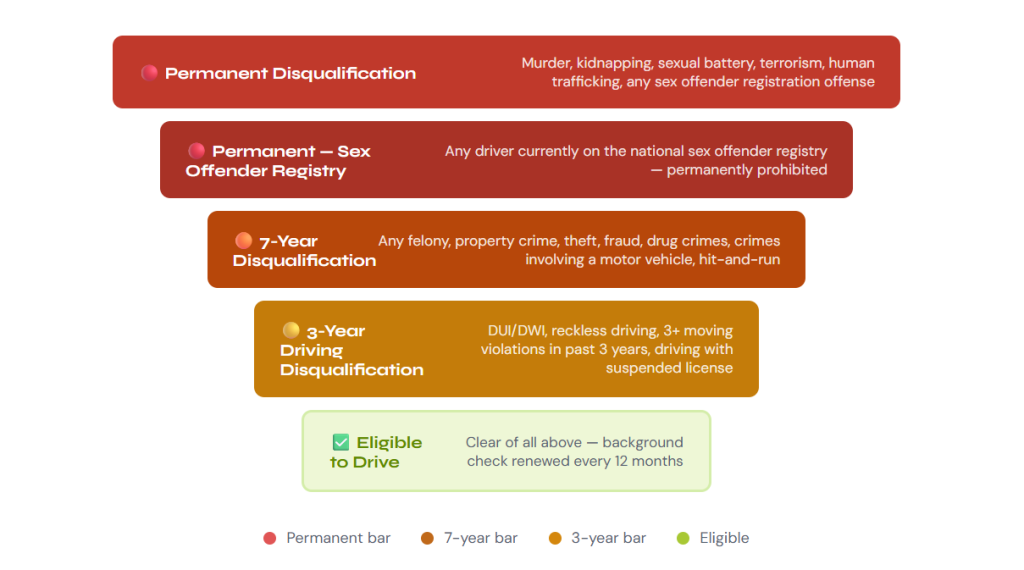
Permanent and 7-Year Disqualifying Offenses
Disqualification Type | Covered Offenses |
Permanent disqualification | Murder, kidnapping, robbery, aggravated assault, sexual battery, terrorism, human trafficking, any offense requiring sex offender registration |
7-year disqualification | Any felony conviction, property crimes, theft, fraud, drug-related crimes, crimes involving use of a motor vehicle, hit-and-run |
3-year disqualification (driving) | DUI/DWI, reckless driving, three or more moving violations in the past three years, driving with a suspended/invalid license |
Ongoing bar | Any driver currently listed on the national sex offender registry is permanently prohibited regardless of when the offense occurred |
Texas law prohibits TNCs from discriminating based on arrest records without convictions; the disqualifying factor must be an actual conviction, not an arrest that did not lead to a conviction. TNCs are required to evaluate each conviction individually.
The Three-Period Insurance Framework , The Most Misunderstood Rule
📸 IMAGE PROMPT: Insurance documents and car keys on a desk, Texas flag in the background , editorial flat-lay photography , 1200px wide |
This is the single most important regulation for Houston rideshare drivers to understand , and the one most likely to leave you financially exposed if you get it wrong. Texas law divides rideshare driving into three distinct insurance periods, each with different coverage requirements. Your personal auto insurance policy does NOT automatically cover all three periods.
The critical gap is Period 1. Your personal auto insurer can and will deny claims that occur while your app is open but you haven’t yet accepted a ride , because you are commercially operating a vehicle, which most personal policies explicitly exclude. Uber and Lyft both provide some contingent liability coverage during Period 1, but it only kicks in if your personal insurer has already denied the claim.
To close this gap, most Houston drivers should purchase a rideshare insurance endorsement from their personal insurer. According to ValuePenguin’s analysis of Texas rideshare insurance, adding rideshare coverage typically increases standard Texas premiums by 15–30% , a meaningful cost that is also a fully tax-deductible business expense for drivers claiming the actual expenses method.
✅ Insurance Providers Offering Rideshare Endorsements in Texas State Farm , Rideshare driver endorsement for Period 1 gap coverage USAA , Available to military members and families Allstate , Rideshare insurance add-on Farmers , Rideshare endorsement, premium increase approx. 30% Progressive , Rideshare endorsement, premium increase approx. 15% GEICO , Commercial rideshare policy option 💡 Tip: Do NOT hide rideshare activity from your insurer. If an insurer discovers undisclosed ridesharing activity after an accident, they can deny your claim and cancel your policy entirely. |
Vehicle Requirements for Texas Rideshare Drivers
Texas law requires TNC vehicles to comply with the Texas Motor Vehicle Code , meaning any vehicle that is street-legal in Texas qualifies at the state level. In practice, however, Uber and Lyft impose significantly more specific vehicle requirements that go well beyond what state law mandates.
State-Mandated Minimum Vehicle Standards
- The vehicle must meet all Texas Motor Vehicle Code requirements (functioning headlights, brake lights, horn, etc.)
- Valid Texas registration and current annual vehicle safety inspection sticker
- No illegal modifications (e.g., non-compliant window tint on front windshield)
- Must carry proof of insurance at all times while operating
Uber & Lyft Vehicle Requirements in Texas (Platform-Specific)
Requirement | Standard (UberX / Lyft) |
Doors | Minimum 4 doors |
Seating capacity | Minimum 5 seat belts including driver; maximum 8 (Lyft standard) |
Vehicle age | Varies by city , typically model year 2010 or newer for standard tier; 2015+ for some markets |
Condition | No major cosmetic damage, working AC/heat, clean interior , platforms do periodic reviews |
Inspection | Must pass Texas annual state inspection. Note: Uber and Lyft do not physically inspect vehicles , drivers self-certify and upload documentation through the app |
Registration | Must be current Texas registration in driver’s name (or immediate family member’s name in some cases) |
Rental vehicles | Both Uber and Lyft allow approved rental vehicles from authorized vendors |
Independent Contractor Status: What Texas Law Says
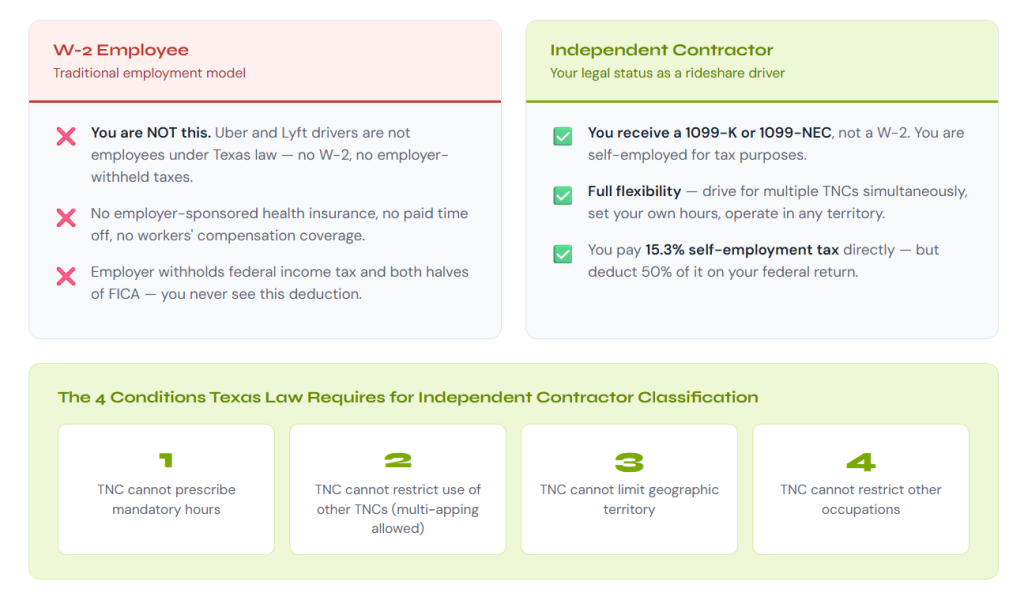
Under Texas Occupations Code Section 2402.114, a TNC driver is classified as an independent contractor , not an employee , if the TNC meets four specific conditions. This classification has major practical implications for drivers: no employer tax withholding, no workers’ compensation coverage, and full self-employment tax responsibility.
Texas Law’s Four Independent Contractor Tests
- No mandatory hours: The TNC does not prescribe the hours a driver must be logged into the digital network
- No exclusivity: The TNC does not restrict the driver from using other TNCs’ digital networks simultaneously (drivers can work Uber and Lyft at the same time)
- No territory limits: The TNC does not limit the geographic territory where the driver may accept rides
- No occupation restrictions: The TNC does not prevent the driver from engaging in other occupations or businesses
Additionally, Texas law allows the TNC and driver to agree in writing that the driver is an independent contractor , which is exactly what Uber and Lyft do through their driver agreements. This codified classification means Texas drivers cannot claim employment status or access employer-provided benefits simply based on how much they drive.
The practical implication: as an independent contractor, you are solely responsible for federal self-employment taxes (15.3%), quarterly estimated tax payments, and your own health insurance. Our guide to 2026 tax deductions for Houston rideshare drivers covers the full strategy for managing these obligations.
TNC Conduct and Safety Obligations Under State Law
Beyond driver eligibility, Texas law imposes specific ongoing operational requirements on both the TNC companies and the drivers themselves. These are not platform policies , they are state law.
What Texas Law Requires of TNCs (the Companies)
- Zero-tolerance intoxication policy: TNCs must maintain and enforce a policy prohibiting any driver who is logged into the digital network from operating with any amount of alcohol, controlled substances, or impairing drugs in their system
- Passenger pre-trip disclosure: Before a passenger enters the vehicle, the TNC must display through the digital network: the driver’s photo and first name, the vehicle make, model, and license plate number, and the fare calculation method
- Fare transparency: TNCs must show passengers the applicable rates and fare calculation method before the ride begins. Surge pricing is explicitly permitted under Texas law but must be disclosed
- Record retention: TNCs must keep all individual ride records for five years and all driver records for at least five years after a driver ceases to be authorized
- Annual driver re-screening: Background and driving history checks must be repeated at least annually for every active driver , not just at initial onboarding
- Accessibility: A TNC driver must provide service to passengers with a service animal. Denying service to a passenger with a service animal is a violation of Texas law
What Texas Law Requires of Drivers
- App-only ride acceptance: Drivers may only accept passengers who have pre-arranged a ride through the TNC’s digital platform. Street hailing is prohibited , you cannot accept a passenger who flags you down or walks up to your vehicle
- No street-hail: Passengers cannot hail a rideshare driver on the street, even if the vehicle displays TNC trade dress
- Zero intoxication: The TNC’s zero-tolerance intoxication policy applies at all times a driver is logged into the app
- Insurance at all times: Driver must maintain the required insurance coverage whenever the app is active, regardless of whether a ride is in progress
Houston-Specific Rules: Airport Operations at IAH and Hobby
Under HB 100’s airport exception, the Houston Airport System (HAS) retains authority to regulate TNC operations at George Bush Intercontinental Airport (IAH) and William P. Hobby Airport (HOU). Houston is one of the few Texas cities that still requires a separate airport-specific permit for rideshare drivers , and operating at IAH or Hobby without this permit is a violation that can result in fines.
📢 IAH Expansion Update , 2025 In 2025, Houston Airports expanded the rideshare pickup zone at Terminal C at IAH , more than doubling its size to handle growing demand. This expansion was completed ahead of planning for the 2026 FIFA World Cup, which Houston is hosting. The Terminal B area also saw construction under United Airlines’ Terminal B Renovation Program , rideshare and limousine staging has been relocated to the SouthEast A/B Garage, Level 1 during this period. Check fly2houston.com for current terminal-specific pickup zone locations before working the airport. For complete current information on Houston Airport ground transportation rules, visit the Houston Airport System official ground transportation page.
|
SB 2807 (2025): Texas's New Autonomous Vehicle Rideshare Law
In June 2025, Governor Greg Abbott signed Senate Bill 2807 into law , the most significant piece of Texas rideshare legislation since HB 100.
It took effect September 1, 2025, and establishes a regulatory framework for autonomous vehicle (AV) rideshare operations in Texas, treating driverless TNC services under the same state licensing structure as human-driver services.
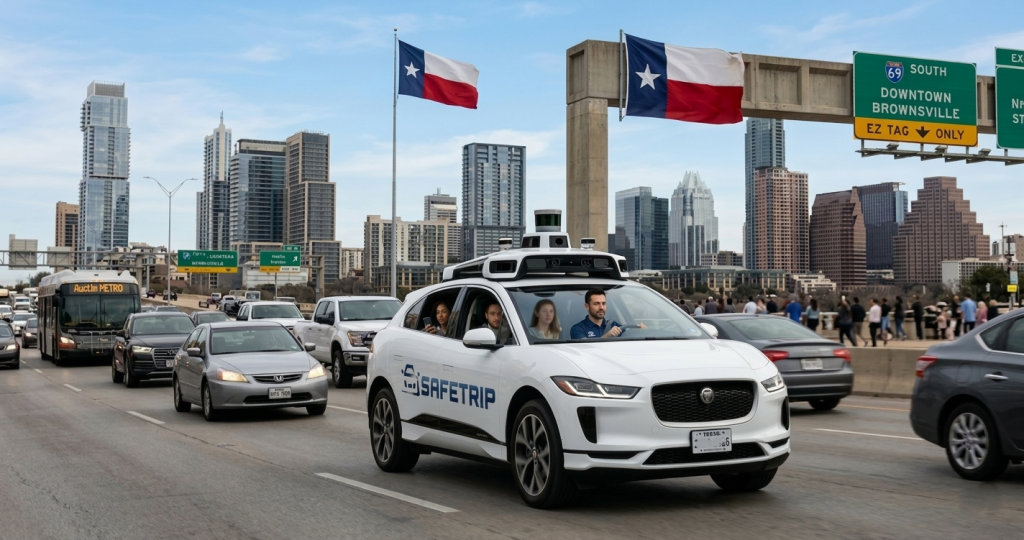
The immediate practical impact: Tesla Robotaxi LLC received a Texas TNC license from TDLR in August 2025, placing it in the same formal regulatory category as Uber and Lyft. Waymo and other AV operators are subject to the same framework. Austin is the current launch market for AV rideshare in Texas; Dallas and other Texas metros are expected to follow in 2026.
What SB 2807 Requires of AV Rideshare Operators
- State permit from TxDMV: Autonomous vehicle companies must obtain a separate permit from the Texas Department of Motor Vehicles (TxDMV) to operate vehicles without a human driver. The TxDMV manages vehicle compliance; TDLR manages the TNC service license
- Three-year public testing requirement: Companies must demonstrate at least three years of testing their automated driving system on public roads with a human operator present before being eligible for a fully driverless permit
- Emergency response plans: AV operators must file first-responder safety plans with the state, including protocols for how autonomous vehicles respond to emergency vehicles and accident scenarios
- Sensor redundancy: Level 4 and Level 5 automated vehicles (those requiring no human driver under any conditions) must meet sensor redundancy requirements
- Collision and incident records: Permit holders must maintain detailed records of all traffic collisions and system failures, and report these to the state annually
- Vehicle identification: Autonomous vehicles must display a visible sticker indicating autonomous operation, including a contact number for incidents
- No local override: SB 2807 explicitly prohibits local governments (including Houston, Austin, and Dallas) from imposing additional regulations on autonomous vehicles operating under the state framework
🔍 What SB 2807 Means for Human Rideshare Drivers SB 2807 does not change the existing rules for human-driver rideshare operations. Human drivers for Uber and Lyft continue operating under the same HB 100 framework as before. The law opens the market to direct competition from driverless vehicle services , Waymo is operating in Austin; Tesla Robotaxi launched in Austin in 2025. AV services operate under the same TDLR TNC licensing , meaning riders interact with them through the same app frameworks. The long-term impact on driver earnings is an open question; the near-term impact in Houston specifically remains limited as of early 2026, with AV deployment concentrated in Austin. Full compliance deadlines for AV operators: May 28, 2026, or 90 days after TxDMV rules take effect , whichever is later. |
Houston Driver Compliance Checklist
Use this checklist to verify your compliance with both state law and Houston-specific requirements:
Requirement | Status to Verify |
TNC platform approval | Confirmed active in Uber/Lyft app , not deactivated or under review |
Valid Texas driver’s license | Not expired, suspended, or restricted |
Vehicle registration | Current Texas registration, not expired |
Annual vehicle inspection | Valid Texas safety inspection sticker |
Period 1 insurance gap coverage | Rideshare endorsement added to personal policy OR confirmed coverage from insurer |
Annual background check renewal | TNC confirms re-screening completed (automatic , but verify via your driver dashboard) |
Houston airport permit | HAS permit obtained from Ground Transportation office , required if working IAH or Hobby |
Trade dress (decals) | Uber or Lyft decals visibly displayed when working Houston airports |
Zero-tolerance intoxication | No alcohol, cannabis, or impairing substances while app is on |
Service animal compliance | Passengers with service animals must be accepted , denying is a violation of Texas law |
Stay Compliant, Stay Protected , and Stay Profitable
Texas’s rideshare regulatory framework is one of the most clearly structured in the country , but only if you know what it actually requires. The most common and costly mistakes Houston drivers make are all avoidable: driving at airports without an HAS permit, carrying personal-only insurance with no Period 1 gap coverage, and missing annual background check renewals that the platform handles quietly in the background.
The regulatory landscape is also actively evolving. SB 2807 and the rollout of autonomous rideshare in Texas will shape the industry’s structure over the next several years , and staying informed about those changes is part of running a professional rideshare operation. The Texas Department of Licensing and Regulation’s TNC portal is the authoritative source for current requirements and any regulatory updates.
Understanding your regulatory obligations also helps you manage the financial side of your business more effectively. Regulatory costs , insurance endorsements, airport permits, background check fees , are all deductible business expenses. Read our guide to 2026 tax deductions every Texas rideshare driver should know for the complete strategy.
🚗 Have Questions About Rideshare Driving in Houston? Whether you’re just starting out as a rideshare driver, dealing with a deactivation, navigating insurance requirements, or planning the smartest routes through Houston’s construction zones , SafeTrip is here to help. We help Houston drivers stay compliant, stay safe, and stay profitable , with practical, up-to-date guidance on the rules, the roads, and the business of rideshare driving in Texas. 👉 Contact SafeTrip today for a free consultation , and drive with confidence knowing you’re covered. |
Official Sources & Further Reading
- TDLR , TNC Laws and Rules (Texas Occupations Code Ch. 2402): tdlr.texas.gov/tnc/laws-rules.htm
- TDLR , TNC Driver Requirements: tdlr.texas.gov/tnc/drivers.htm
- TDLR , TNC Operations Guide: tdlr.texas.gov/tnc/operations.htm
- TDLR , Public Information About Ridesharing: tdlr.texas.gov/tnc/info.htm
- TxDMV , SB 2807 Autonomous Vehicle Rules: txdmv.gov/about-us/general-counsel/proposed-and-adopted-rules-2025
- City of Austin , Autonomous Vehicles Overview: austintexas.gov/page/autonomous-vehicles
- Houston Airport System , Ground Transportation: fly2houston.com/hou/taxis-ride-apps
- ValuePenguin , Texas Rideshare Insurance Requirements: valuepenguin.com/rideshare-car-insurance-texas