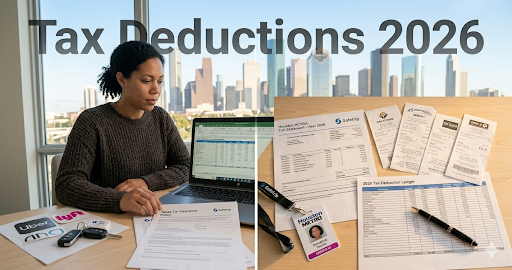
Tax Deductions Every Rideshare Driver Should Know in 2026
The typical Uber or Lyft driver misses $4,000–$7,000 in tax deductions every single year. That’s thousands of dollars left on the table , money you legally earned the right to keep. If you’re driving in Houston, Texas, the situation is actually better than most states: Texas has no state income tax, which means every federal deduction you claim goes directly into your pocket.
In 2026, there are more deductions available to rideshare drivers than ever before , including a brand-new tips deduction that didn’t exist in previous years. Whether you’re full-time on the road or running Uber as a side income alongside your regular job, understanding your tax deductions as an independent contractor is one of the most important financial moves you can make this year.
This guide is written specifically for Houston and Texas rideshare drivers. We’ll cover every deduction you qualify for, explain the Texas-specific advantages, and show you exactly how to keep the records the IRS requires. And if you’re still weighing whether driving full-time makes financial sense, check out our breakdown of ridesharing costs vs. car ownership in Houston to understand the full picture.
🌟 Texas Advantage: No State Income Tax Texas is one of only nine states with no personal state income tax. As a Houston rideshare driver, you only file federal taxes , not a separate state income return. Every dollar you deduct reduces your federal taxable income directly. For a driver earning $45,000/year, this can mean $3,000–$6,000 less in total tax owed compared to drivers in states like California or New York. |
How Rideshare Taxes Work in 2026: The Basics
Uber and Lyft do not withhold taxes from your pay. You are classified as an independent contractor, not an employee , which means you receive a 1099-K or 1099-NEC instead of a W-2, and you’re responsible for paying both sides of self-employment tax.
For Tax Year 2025 (the return you file in 2026), the self-employment tax rate is 15.3% , covering Social Security (12.4%) and Medicare (2.9%). On top of that, you owe federal income tax on your net profit. Combined, these obligations can easily reach 30–40% of your gross rideshare earnings if you don’t claim the deductions you’re entitled to.
You report rideshare income on IRS Schedule C (Form 1040) , Profit or Loss from Business. Your deductions go on the same form, and you pay tax only on the net profit (income minus deductions). Every legitimate deduction you claim reduces both your income tax and your self-employment tax.
Tax Document | What It Reports |
Form 1099-K | Gross ride payments processed , includes Uber/Lyft’s cut, not just yours |
Form 1099-NEC | Bonuses, referrals, incentives, sign-on payments |
Schedule C (1040) | Where you report income AND claim all business deductions |
Schedule SE (1040) | Calculates self-employment tax on your net profit |
Form 1040-ES | Used to make quarterly estimated tax payments |
⚠️ Critical: 1099-K Reports Gross Fares , Not Your Take-Home Your 1099-K shows the full amount the passenger paid , including Uber’s or Lyft’s service fee. Example: Passenger pays $30. Uber keeps $7.50 (25%). Your 1099-K shows $30, not $22.50. The $7.50 commission is a deductible expense , but you must claim it on Schedule C. Do NOT use your bank deposit total as your income. Use the 1099-K and deduct the platform fees. |
Deduction #1: The Mileage Deduction , Your Biggest Write-Off
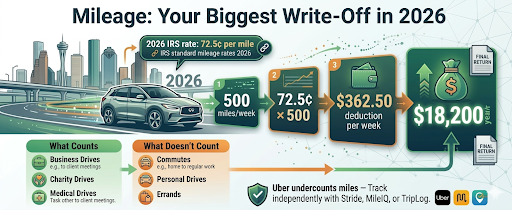
For most Houston rideshare drivers, the mileage deduction is by far the largest single write-off on their tax return. The 2026 IRS standard mileage rate is 72.5 cents per mile , up 2.5 cents from 2025’s rate of 70 cents per mile. If you drive 500 miles a week for rideshare, that’s a potential $350 deduction per week , adding up to over $18,200 in deductions for the year.
What Miles Count as Deductible?
- Miles while a passenger is in your car
- Miles driving to pick up a passenger after accepting a ride request
- Miles spent repositioning to a higher-demand area after dropping off a passenger
- Miles driving to a car wash, detailing appointment, or mechanic for rideshare-related maintenance
- Miles driving to pick up supplies (phone mounts, USB chargers, water for passengers)
What does NOT count: Miles driving from home to where you start accepting rides (your first deadhead of the day). Miles on personal errands. Miles when the app is off entirely.
Standard Mileage vs. Actual Expenses , Which Should You Choose?
You must choose one method for the year and stick with it. Here’s how they compare for a typical Houston driver:
Method | How It Works | Best For |
Standard Mileage72.5¢/mile (2026) | Multiply business miles × $0.725. Simple, no receipts needed for vehicle costs. | Most drivers. Easiest to track, covers gas, repairs, depreciation in one rate. |
Actual Expenses | Deduct real costs: gas, insurance, repairs, maintenance, depreciation or lease payments. | Drivers with high actual vehicle costs or a newer vehicle with heavy depreciation. |
Key Rule | Cannot switch from actual expenses to standard mileage in subsequent years if you used actual in year 1. | Start with standard mileage if uncertain , you keep flexibility to switch later. |
💡 Houston Driver Tip: Track ALL Miles , Uber Undercounts
|
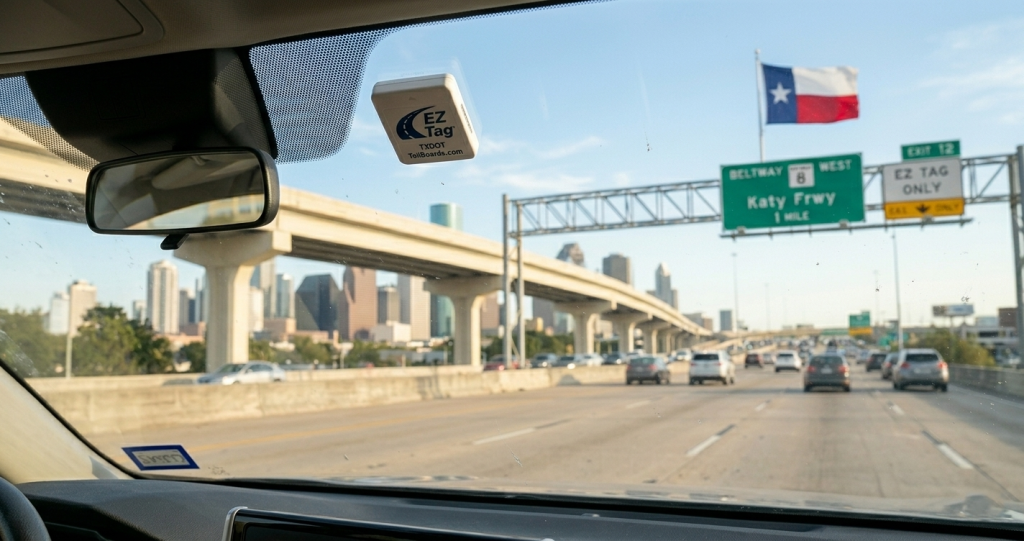
Houston is one of the most toll-heavy cities in the United States, with over 800 miles of toll roads managed by the Harris County Toll Road Authority (HCTRA) and TxDOT.
If you’re driving for Uber or Lyft in Houston, you’re almost certainly using toll roads daily , and every single toll you pay while actively driving for rideshare is a fully deductible business expense.
pay with an EZ Tag, a TollTag, or cash. The key requirement: the toll must occur while you’re actively working , app open, driving to a pickup, or transporting a passenger.
Houston Toll Roads Commonly Used by Rideshare Drivers
- Hardy Toll Road: Runs parallel to I-45 North , heavily used for airport runs to IAH and north Houston pickups
- Sam Houston Tollway (Beltway 8): Circles the city , used constantly for suburb-to-suburb and airport routes
This applies whether you pay with an EZ Tag, a TollTag, or cash. The key requirement: the toll must occur while you’re actively working , app open, driving to a pickup, or transporting a passenger.
Houston Toll Roads Commonly Used by Rideshare Drivers
- Hardy Toll Road: Runs parallel to I-45 North , heavily used for airport runs to IAH and north Houston pickups
- Sam Houston Tollway (Beltway 8): Circles the city , used constantly for suburb-to-suburb and airport routes
- Westpark Tollway: Connects west Houston and Energy Corridor riders to downtown
- Fort Bend Tollway / Grand Parkway (TX-99): Used for Katy, Sugar Land, and outer suburban pickups
- Ship Channel Bridge / Airport Connector roads: IAH and Hobby airport routes involve multiple toll-road segments
💡 EZ Tag Makes Record-Keeping Easy
|
Parking fees , including airport staging lots, downtown parking while waiting for rides, or parking while running rideshare errands , are also deductible. For Houston drivers working IAH or Hobby, the Transportation Network Company (TNC) staging area fees paid per trip are fully deductible as a business cost.
Deduction #5: Phone, Data Plan, and Technology
Your smartphone is your entire business as a rideshare driver , without it, you can’t accept a single ride. The portion of your phone and data plan used for rideshare work is fully deductible as a business expense.
The key is calculating the business-use percentage. If you drive for rideshare 40 hours per week and your total weekly phone use is 60 hours, your business-use percentage is approximately 67%. You can deduct 67% of your monthly phone bill.
Technology Expenses That Are Deductible
- Cell phone bill (business % only): Monthly service plan, prorated to your rideshare hours vs. total hours
- Dedicated rideshare phone: If you maintain a second phone exclusively for rideshare apps, the cost is 100% deductible
- Phone mount / dashboard holder: Required equipment , fully deductible
- Phone charging cables and car chargers: Used for your device and offered to passengers , deductible
- Bluetooth headset or speakerphone: Used for navigation audio , deductible business equipment
- Dashcam: Increasingly common for safety and dispute documentation , deductible as business equipment
- Mileage tracking app subscription: MileIQ, Everlance, TripLog , the annual fee is deductible as a business software expense
- GPS device (if separate from phone): Fully deductible as required business equipment
For Houston drivers especially, a quality dashcam is worth considering. Heavy Houston traffic , particularly on I-45 and the construction zones under the NHHIP project , creates more incident risk. The dashcam cost is fully deductible, and the footage can be invaluable for insurance disputes.
Deduction #6: Vehicle Expenses (If You Use Actual Expenses Method)
If you chose the actual expenses method instead of standard mileage, you can deduct the business-use percentage of every vehicle-related cost you incur. Calculate business-use percentage as: Business Miles ÷ Total Miles for the year.
Example: You drove 30,000 total miles in 2025, of which 22,000 were for rideshare (73% business use). You can deduct 73% of every expense below.
Actual Vehicle Expense | Notes |
Gas / fuel | All fuel costs × business-use % |
Car insurance | Annual premium × business-use % , but see rideshare insurance note below |
Repairs & maintenance | Oil changes, tires, brakes, belts × business-use % |
Vehicle registration | Annual TxDMV registration fee × business-use % |
Car washes & detailing | To maintain passenger ratings , deductible at business-use % |
Lease payments | Monthly lease payment × business-use % (if leasing) |
Depreciation | For owned vehicles , complex; IRS Publication 946 or use tax software |
Loan interest | Interest portion of car payment × business-use % (NOT principal) |
⚠️ Important: Rideshare-Specific Insurance Gap in Texas
|
Deduction #7: Passenger Supplies and In-Car Amenities
Top-rated drivers in Houston often provide small amenities to improve passenger experience and protect their ratings , and all of these costs are deductible business expenses when purchased specifically for passengers.
- Water bottles: A case of bottled water kept in the car for passengers , deductible
- Snacks and gum: Mints, small snacks offered to riders , deductible
- USB charging cables (passenger-side): For passengers to charge their phones , deductible
- Hand sanitizer and PPE: Masks, wipes, sanitizer , deductible health and safety supplies
- Air fresheners and cleaning supplies: Keeping the vehicle clean and fresh for passengers , deductible
- Tissues and paper towels: In-car supplies , deductible
- Phone charger splitters / multi-port chargers: For passenger use , deductible
Keep your receipts. Supplies purchased at Walmart, HEB, Costco, or Amazon all count , but the IRS needs documentation. Take a photo of every receipt with your phone immediately after purchase, or use an accounting app like Wave (free) or QuickBooks Self-Employed to log purchases in real time.
Deduction #8: Health Insurance Premiums
If you pay for your own health insurance , as most full-time rideshare drivers do , you may be able to deduct 100% of your health, dental, and vision insurance premiums as a self-employed person. This is one of the most valuable and overlooked deductions available to gig workers.
This deduction is claimed on Schedule 1 of Form 1040 (not Schedule C), and it reduces your adjusted gross income directly. You cannot claim this deduction if you were eligible for employer-sponsored health coverage through a spouse or a part-time employer during the year.
💡 Houston Drivers: Check the ACA Marketplace for Lower Premiums Because Texas did not expand Medicaid, Houston drivers earning above the federal poverty level may qualify for subsidized health coverage through healthcare.gov. Self-employed rideshare income qualifies you to shop on the ACA Marketplace. Lower your premium through ACA subsidies AND deduct your remaining out-of-pocket premium cost. This combination can dramatically reduce both your tax burden and your monthly insurance cost. |
Deduction #9: The Self-Employment Tax Deduction
Here’s one most drivers completely overlook: the IRS allows you to deduct 50% of your self-employment tax from your gross income. This is an automatic deduction claimed on Schedule 1 of Form 1040.
Why does this exist? Because when you’re an employee, your employer pays half of your Social Security and Medicare taxes. As a self-employed driver, you pay both halves , but the IRS acknowledges this by letting you deduct the employer’s half. For a driver paying $6,000 in self-employment tax, this means a $3,000 automatic deduction that directly reduces your taxable income.
Don’t Forget: Quarterly Estimated Tax Payments
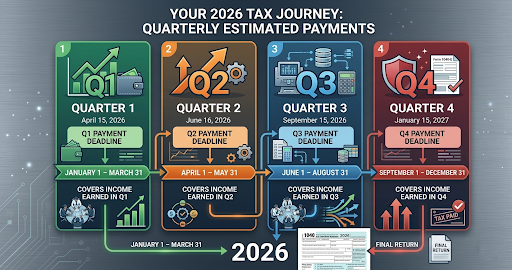
Because Uber and Lyft withhold nothing from your pay, the IRS expects you to make estimated tax payments four times per year. If you owe more than $1,000 in taxes at filing time and didn’t make estimated payments, you may face IRS penalties on top of your tax bill.
2026 Quarterly Tax Deadline | Covers Income Earned |
April 15, 2026 | January 1 – March 31 |
June 16, 2026 | April 1 – May 31 |
September 15, 2026 | June 1 – August 31 |
January 15, 2027 | September 1 – December 31 |
A practical rule of thumb: set aside 25–30% of your net rideshare income (after deductions) each time you receive a payment. Transfer it immediately to a separate savings account earmarked for taxes. This way, quarterly payments never come as a shock.
You can make estimated payments online through the IRS Electronic Federal Tax Payment System (EFTPS) at eftps.gov , free, fast, and available 24/7.
Record-Keeping: What the IRS Requires
All deductions require documentation. The IRS can disallow any deduction you can’t prove with records. Here’s exactly what to keep:
Deduction | Records Required |
Mileage | Date, start/end location, business purpose, miles , use a mileage app daily |
Tolls | EZ Tag annual statement or receipts with date, location, amount |
Platform fees/commissions | Annual Uber/Lyft tax summary or earnings breakdown |
Phone/tech expenses | Monthly bill + calculation of business-use percentage |
Passenger supplies | Receipts (photo or digital) with date and business purpose noted |
Vehicle expenses (actual) | All receipts, insurance statements, lease/loan documents |
Health insurance | Insurance premium statements and proof of payment |
Tips income | Uber/Lyft earnings statement showing tips line item separately |
📱 Best Free Apps for Houston Rideshare Drivers
|
Complete 2026 Tax Deductions Summary for Houston Rideshare Drivers
Deduction | Typical Value | Texas/Houston Notes |
Mileage (72.5¢/mile) | $5,000–$18,000+/year | Track independently , Uber undercounts |
Tips (new 2026 deduction) | Up to $25,000 | New law , check IRS.gov for filing details |
Platform commissions & fees | $3,000–$8,000/year | From 1099-K gross vs. your take-home |
Tolls (EZ Tag) | $500–$2,500/year | Download HCTRA annual statement in Jan |
Airport permit fees | $200–$800/year | IAH and Hobby , per-trip TNC fees |
Phone & data plan (biz %) | $300–$900/year | Calculate biz hours ÷ total hours |
Dashcam + tech equipment | $50–$400/year | Especially valuable on Houston freeways |
Passenger supplies | $200–$600/year | Keep every HEB/Walmart/Amazon receipt |
Health insurance premiums | $2,400–$8,400/year | Check ACA marketplace for subsidy options |
Rideshare insurance add-on | $200–$600/year | Required gap coverage in Texas |
SE tax deduction (50%) | $1,500–$4,000/year | Automatic , claimed on Schedule 1 |
Vehicle expenses (actual) | Varies widely | Only if using actual method , not with mileage |
The Bottom Line: Track Everything, Claim Everything
Houston rideshare drivers have a genuine tax advantage that most don’t fully use. With no Texas state income tax, a new tips deduction worth up to $25,000, and one of the highest mileage rates in years at 72.5 cents per mile, 2026 is the best year yet to get serious about your tax deductions.
The difference between a driver who tracks diligently and one who doesn’t isn’t marginal , it’s $4,000 to $7,000 per year in real money. For a Houston driver putting in 40 hours a week, that’s the difference between rideshare being profitable and rideshare being a break-even grind.
Start with the two biggest items: download a mileage app today and pull your annual EZ Tag toll statement from your HCTRA account. Those two steps alone will capture the majority of your deductions. For everything else , supplies, phone, platform fees , build the habit of photographing every receipt in the moment.
And remember: if you’re still deciding whether full-time ridesharing makes financial sense in Houston, our complete comparison of ridesharing vs. car ownership costs in Houston will give you the numbers to make that decision clearly.
🚗 Drive Smarter , On the Road and at Tax Time SafeTrip helps Houston drivers make smarter decisions , whether that’s the best routes to take, the real costs of rideshare driving, or resources to help your driving business run more profitably. Have questions about rideshare driving in Houston? Want advice on routes, insurance, or making the most of your earning hours? Our team is here to help. 👉 Contact SafeTrip today for a free consultation , and let us help you drive smarter, earn more, and keep more of what you make. |
Sources & Further Reading
- IRS Gig Economy Tax Center , irs.gov/businesses/small-businesses-self-employed/gig-economy-tax-center
- IRS Standard Mileage Rates 2026 , irs.gov/tax-professionals/standard-mileage-rates
- Tips Deduction Guidance (Tax Year 2025/2026) , taxoutreach.org rideshare deductions
- TurboTax: Tax Tips for Rideshare Drivers , turbotax.intuit.com rideshare guide
- IRS EFTPS (Quarterly Tax Payments) , eftps.gov
- HCTRA EZ Tag Toll Road Network , hctra.org